Case study · Golf & leisure value-add · Phoenix, AZ
Ahwatukee Golf Club
Independent underwriting of an 18-hole daily-fee golf course in Ahwatukee, modeling a $5.3M acquisition, $1.1M of phased improvements, and a seven-year golf and hospitality operating plan.
Independent student underwriting. Operating assumptions, financing, and returns are model estimates, not disclosed operating results. Debt terms are estimated; transaction references come from public sources and are not independently verified.
Download Excel ModelView the complete assumptions, cash flows, and projected returns.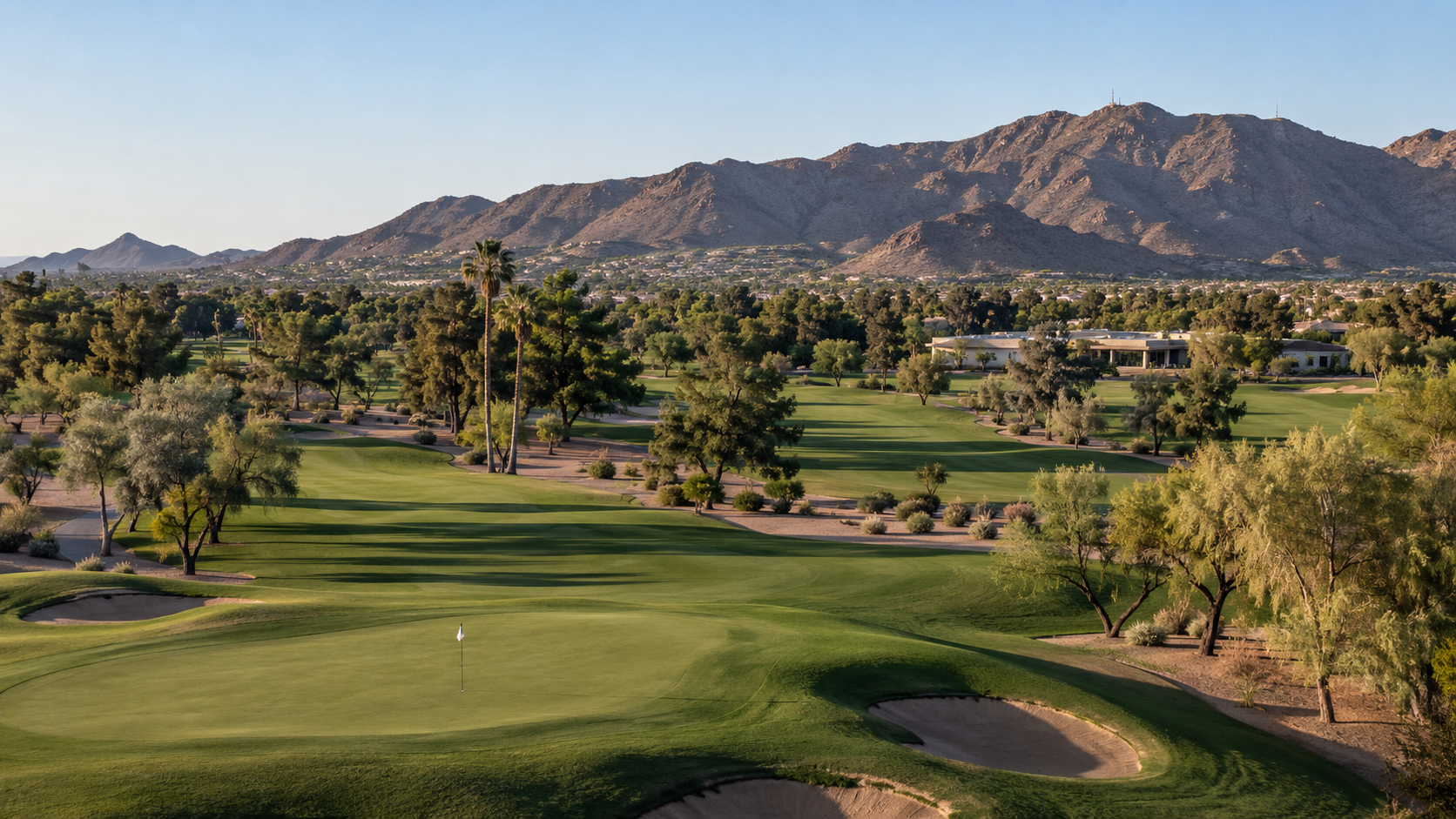
- Levered IRR
- 22.2%
- 7-year hold · workbook output
- Levered MOIC
- 3.68×
- $11.0M returned on $2.99M equity
- Y7 NOI
- $868K
- 26.5% modeled NOI margin
- Exit Value
- $10.85M
- at an 8.00% exit cap
01 · The Property
A daily-fee golf asset with a phased hospitality and range improvement plan.
ViaWest Group acquired the course in July 2026 for $5.3M as a value-add play, partnering with Paradigm Golf as the operator. The subject is Ahwatukee Golf Club at 12432 S 48th Street in South Phoenix’s Ahwatukee Foothills — a 1974-vintage, John Bulla-designed, 18-hole course measuring 6,713 yards at par 72. This case study is an independent underwrite of that acquisition from the perspective of an outside analyst.
The $5.3M purchase is modeled with $106K of closing costs and a $500K day-one reserve, for $5.906M of total uses. Sources comprise $2.915M of senior debt at 55% LTV and $2.991M of common equity. The $1.1M improvement program deploys $500K in Year 1 (driving range and irrigation) and $300K in each of Years 2 and 3 (clubhouse renovation and food and beverage expansion).
02 · Investment Thesis
A cheap basis, an experiential operator, and limited nearby competition.
Basis
My estimated Year 1 NOI implies an entry yield of roughly 12%, which is at the high end of the 8–12% range daily-fee courses typically trade at. The spread between entry basis and a stabilized exit valuation creates return cushion — but the magnitude depends on actual operating execution and exit market conditions, both of which carry meaningful uncertainty.
Operations
Year 1 rounds start at 29,750 after a 15% operator-transition discount, then grow 2% a year with 3.5% greens-fee growth. F&B, range, and pro shop revenue take total revenue from $2.45M to $3.27M, with Paradigm Golf’s Dobson Ranch model pointing toward a more experiential product.
Capital
Senior debt at 55% LTV and 7% carries two years of interest-only, then 25-year amortization over a seven-year term matched to the hold. DSCR stays between 2.8× and 3.4× throughout.
03 · Financial Analysis
NOI rises from $649K to $868K by Year 7.
The operating schedule holds expenses at 73.5% of revenue, maintaining a 26.5% NOI margin while NOI compounds at about 5% a year. The Returns sheet shows a 22.2% levered IRR and 16.5% unlevered IRR. A $10.85M gross exit uses Year 7 NOI at an 8.00% cap, with 2% sale costs, return of the reserve, and $2.60M of remaining debt repaid at sale.
- Levered IRR
- 22.2%
- Levered MOIC
- 3.68×
- Unlevered IRR
- 16.5%
- Unlevered MOIC
- 2.59×
- Y7 DSCR
- 3.36×
04 · Key Assumptions
Underwriting Summary
- Purchase Price
- $5,300,000
- Course / Vintage
- 18 holes · par 72 / 1974 · John Bulla
- Submarket
- Ahwatukee Foothills / South Phoenix
- Y1 Rounds / Greens Fee
- 29,750 / $48
- Capex Plan
- $1.1M · Years 1–3
- Total Uses / Reserve
- $5.906M / $500K
- Senior Debt / LTV
- $2.915M / 55%
- Initial Common Equity
- $2,991,000
- Rate / Loan Term
- 7.00% / 7 years · 2-year IO
- Hold / Exit Cap
- 7 Years / 8.00%
05 · Analyst Takeaway
Key Takeaways
This is as much an exit-valuation case as an operating-improvement case. The returns bridge attributes about 47% of the $8.0M levered profit to cap-rate movement — from a roughly 12.2% implied entry yield to an 8.00% exit cap — with 31% from operating cash flow, 22% from NOI growth, and 4% from debt paydown, offset by 4% of transaction costs. The key risk is that cap rate compression fails to materialize. If the exit cap holds at 9–10% instead of 8%, the sensitivity table shows a levered multiple of roughly 3.0–3.3× — still a healthy outcome, but materially below the base case. The Golf Entertainment Repositioning — Toptracer bays, a par-3 course, and expanded F&B for about $3.0M more — is an unmodeled upside concept, not part of these base-case schedules.