Case study · Industrial net lease · Buckeye, AZ
Pecos Logistics
Independent underwriting of a 215,000 SF Class A distribution facility in Buckeye, Arizona, modeling a $44.0M acquisition of a single-tenant, absolute NNN asset with CMBS financing over a five-year hold.
This case study models a $44M acquisition of a 215,000 SF Class A industrial facility in Buckeye, AZ. Property-level details reflect typical Class A industrial product in the Phoenix MSA. Financing structure ($26.4M CMBS at 6.00%, 10-year interest-only), operating assumptions, and projected returns are my independent underwriting.
Download Excel ModelView the complete assumptions, cash flows, and projected returns.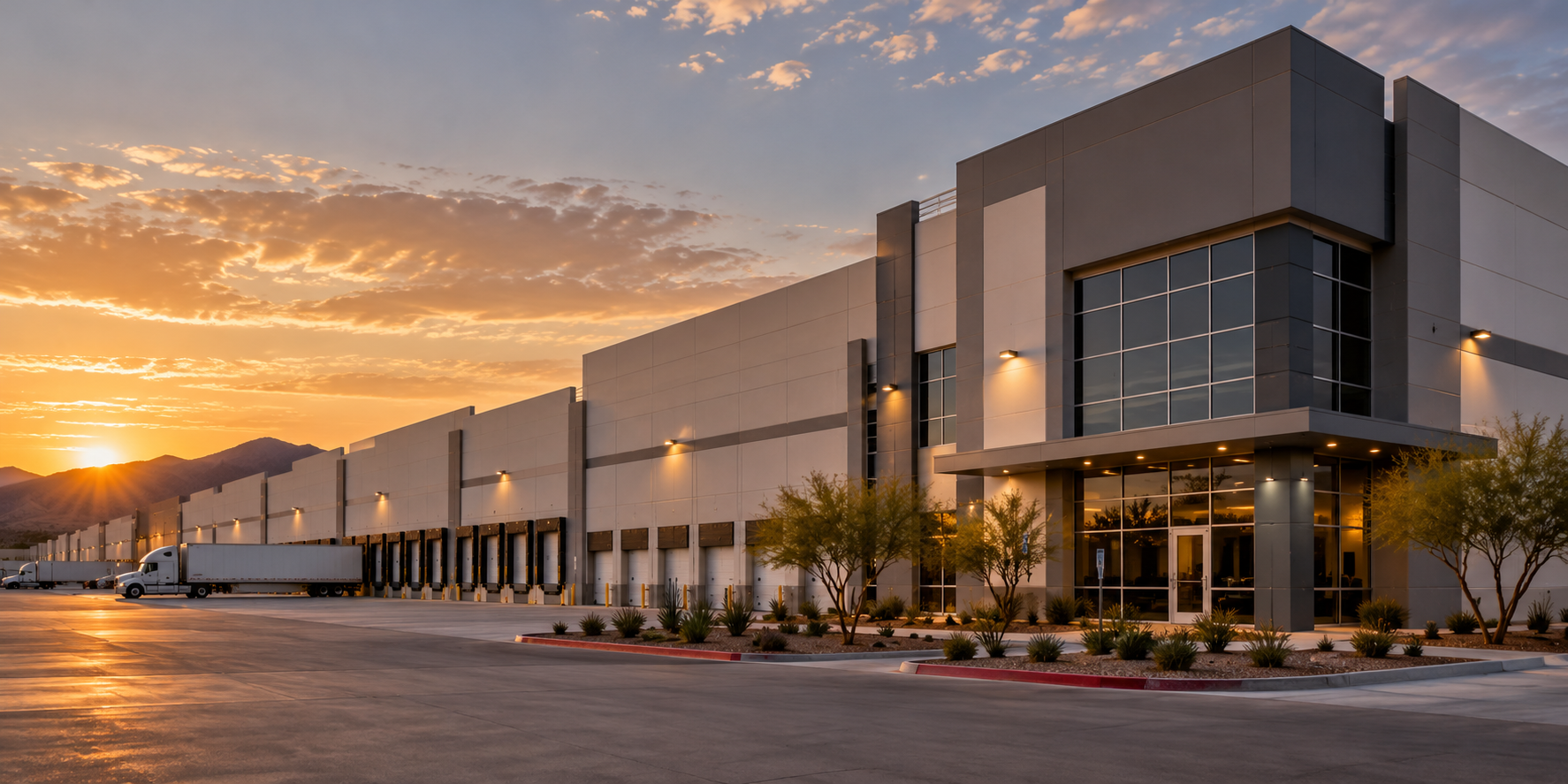
- Levered IRR
- 9.2%
- 5-year hold
- Equity Multiple
- 1.50×
- on $18.3M equity
- Y5 NOI
- $2.85M
- 12.6% growth over hold
- Exit Value
- $48.9M
- at 6.00% exit cap
01 · The Property
A credit-tenant net lease in one of the deepest big-box markets in the Southwest.
The subject is a 2024-vintage, 215,000 SF Class A distribution facility in Buckeye, Arizona — part of the Southwest Valley submarket within the Phoenix MSA — modeled as a $44.0M acquisition at $205 per square foot and a 5.75% going-in cap rate. The building offers 36-foot clear heights, 48 dock-high doors, and 4 drive-in doors on a 12.5-acre site.
The business plan is deliberately simple: acquire a credit-tenant NNN asset at a stabilized market cap rate, collect contractual 3.0% rent escalations over five years, and exit at a modestly expanded 6.00% cap. A national 3PL occupies 100% of the building on a 10-year absolute NNN lease commencing at close, with no renovation, no re-tenanting, and no vacancy during the hold. Financing is a $26.4M non-recourse CMBS loan at 60% LTV, fixed at 6.00% on a full interest-only basis.
02 · Investment Thesis
Contractual cash yield and escalations, with no reliance on cap compression.
Tenancy
A national 3PL on a 10-year absolute NNN lease commencing at close eliminates vacancy, reimbursement, and capex exposure during the five-year hold.
Operations
Contractual 3.0% annual rent escalations on $12.00/SF starting rent grow NOI from $2.53M to $2.85M — a 3.0% NOI CAGR with an 89.5% margin.
Capital
Initial in-place leverage is slightly negative — the 5.75% going-in cap rate is below the 6.00% CMBS interest-only borrowing cost. However, 3% annual rent escalations grow NOI steadily through the hold, flipping the leverage spread positive by Year 2-3 and compounding equity returns from Year 3 onward. The thesis is yield-growth, not day-one spread.
03 · Financial Analysis
NOI grows $318K over the hold.
With the lease commencing at close and zero vacancy modeled, NOI rises from $2.53M in Year 1 to $2.85M in Year 5 on contractual escalations alone. Debt coverage improves from 1.58× to 1.78×, supporting a $48.9M gross exit at a 6.00% cap rate.
- Levered IRR
- 9.2%
- Levered MOIC
- 1.50×
- Unlevered IRR
- 7.4%
- Unlevered MOIC
- 1.38×
- Avg Cash-on-Cash
- 5.9%
04 · Key Assumptions
Underwriting Summary
- Purchase Price
- $44,000,000
- Price / SF
- $205
- Rentable SF / Vintage
- 215,000 / 2024
- Submarket
- Buckeye / SW Valley, Phoenix MSA
- Occupancy at Close
- 100%
- Going-In Cap
- 5.75%
- Senior Debt
- $26.4M · Non-recourse CMBS
- LTV / Rate
- 60% / 6.00% · Full IO
- Common Equity
- $18,300,000
- Hold / Exit Cap
- 5 Years / 6.00%
05 · Analyst Takeaway
Key Takeaways
This is a yield-and-escalation deal, not a value-creation deal. The returns bridge attributes 59% of equity profit to operating cash flow and 76% to NOI growth, offset by a 23% drag from exiting 25 basis points wide of the entry cap and 13% of transaction costs — producing a modeled 9.2% levered IRR and 1.50× MOIC. Because the loan is fully interest-only, there is no debt paydown in the bridge; returns hinge on the tenant's credit and the exit cap, making this a defensible but single-tenant-concentrated profile. Negative in-place leverage is normal for Class A industrial acquisitions in 2026 — cap rates have compressed below CMBS debt costs across most core industrial markets. The investment thesis isn't a day-one cap-vs-rate arbitrage; it's a contractual cash flow bet on the tenant's 10-year NNN lease with 3% annual escalations, with modest cap compression at exit as the stabilized industrial market continues to attract core capital.